
You found a soft lump somewhere on your body.
You pressed it. It moved. It did not hurt. You told yourself it is probably nothing. Then you spent twenty minutes online, half-convinced yourself it is a lipoma, and landed here with one real question.
Which doctor do I even go to for this?
But underneath that question is something else. Something unspoken.
You are not just looking for a name. You are trying to avoid the wrong clinic, unnecessary surgery, and the quiet anxiety of not knowing what that lump actually is.
That fear is valid. Let me give you a straight answer.
Here Is the Truth
Most people do one of two things. They delay seeing anyone for months. Or they walk into the nearest clinic without knowing which specialist actually handles this.
Both are planning failures. Not bad luck.
Nobody tells you clearly which doctor to consult for lipoma, in what order, and why. So let me do exactly that.
Which Doctor to Consult for Lipoma: The Right Path
This is the part most people miss. There is no single answer. The right doctor depends on where the lipoma is, how large it is, and what you need done.
General Physician First. Always.
Before anything else, see your GP.
Not a surgeon. Not a skin clinic. Your general physician first.
Why? Because not every soft lump is a lipoma. Cysts, swollen lymph nodes, and in rare cases something more serious can feel almost identical from the outside. Your GP examines the lump, gives you a working diagnosis, and decides where to send you next. That step cannot be skipped.
General Surgeon for Most Removals
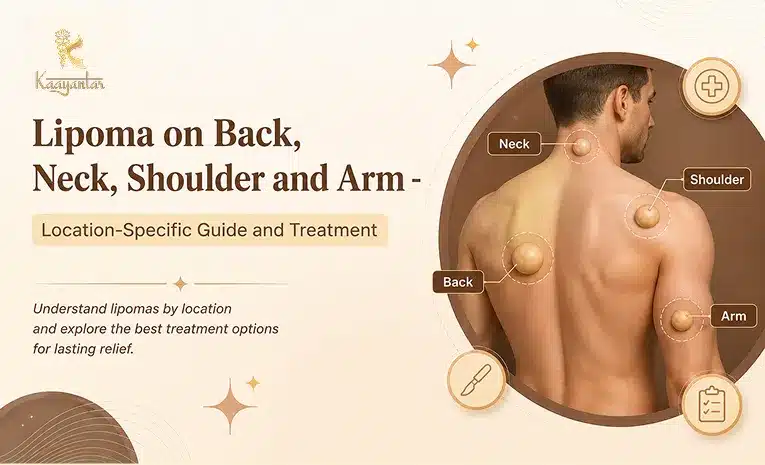
For lipomas on the back, shoulder, arm, abdomen, or thigh, a general surgeon is your specialist.
Removal is routine. Local anaesthesia. Short procedure. Same-day discharge in most cases. This is the most common and cost-effective route for the majority of patients.
Plastic Surgeon for Visible Areas
If the lipoma is on your face or neck, go to a plastic surgeon.
The removal is the same procedure. What changes is precision. Plastic surgeons are trained specifically in minimising visible scarring. For cosmetically sensitive areas, this difference matters enormously in your final result.
Dermatologist for Small Surface Lipomas
For smaller lipomas sitting very close to the skin, a dermatologist can assess and sometimes remove them. They are also a good starting point if you are unsure whether what you have is a lipoma, a cyst, or something else entirely.
When an Oncologist Is Involved
Rare. But worth knowing.
If a lump grows rapidly, feels firm, or does not move freely, your surgeon may refer you further. A liposarcoma can occasionally resemble a lipoma. This is uncommon. But it is exactly why self-diagnosis is dangerous.
Natural Remedies: The Honest Answer
What we see often in consultation is patients who waited a year. Tried castor oil. Turmeric paste. Apple cider vinegar. Hoped the lump would shrink.
It did not.
Natural methods may support your body. They do not remove a lipoma.
No herbal remedy dissolves a benign fatty tumour. And waiting is not neutral. It’s easy to remove a lipoma that is one centimeter long. A four-centimetre lipoma means a longer incision, more involved procedure, and a more visible scar.
Waiting makes the problem more complicated. Not less.
Diagnosis: This Is Where Things Go Wrong
Most blogs skip this part. They should not.
People self-diagnose a lipoma based on a Google search. They wait months. Sometimes years. Then the lump changes slightly. Becomes firmer. Feels different. Now they are anxious and wondering what they missed.
Here is what actually goes wrong. People assume that because the lump is soft and painless, it cannot be serious. That assumption is usually correct. But not always.
The only way to know for certain is a proper clinical examination. Sometimes an ultrasound. Occasionally a biopsy after removal.
Do not self-diagnose. Do not wait more than a few weeks without one proper consultation. If the lump changes in any way, see someone immediately. Delay is not a conservative choice. It is a risk.
Honest Risks Before You Decide
Scarring is real. Every excision leaves a mark. At one month it appears red and raised. At six months it softens considerably. By eighteen months most patients are genuinely surprised by how much it has faded. The trade is simple: a flat scar where a visible lump used to be. Most people find that worth it.
Recurrence at the same site is rare when removed properly. New lipomas may develop elsewhere over time. That is unrelated to the original removal.
Why Kaayantar
This is what it looks like in real life:
- Every case is examined individually before any recommendation is made.
- You are told honestly whether removal is needed now or monitoring is appropriate.
- Scarring timelines are discussed in full before you consent to anything.
- Pricing is transparent from the first consultation. No surprises.
- Post-removal follow-up is part of your care, not an afterthought.
Patients return not because we promised the best outcomes. Because we told them the truth from day one.
Stop guessing.
One proper consultation answers every question you have spent weeks searching for.
Book with Kaayantar today. Know what it is. Know your options. Move forward clearly.
Because a lump left unexamined does not wait. And neither should you.
| Other Related Post | |
| How to Remove Lipoma Without Surgery | How to Remove a Lipoma Yourself |
| How to Reduce Lipoma Naturally | Lipoma, Causes, Symptoms |